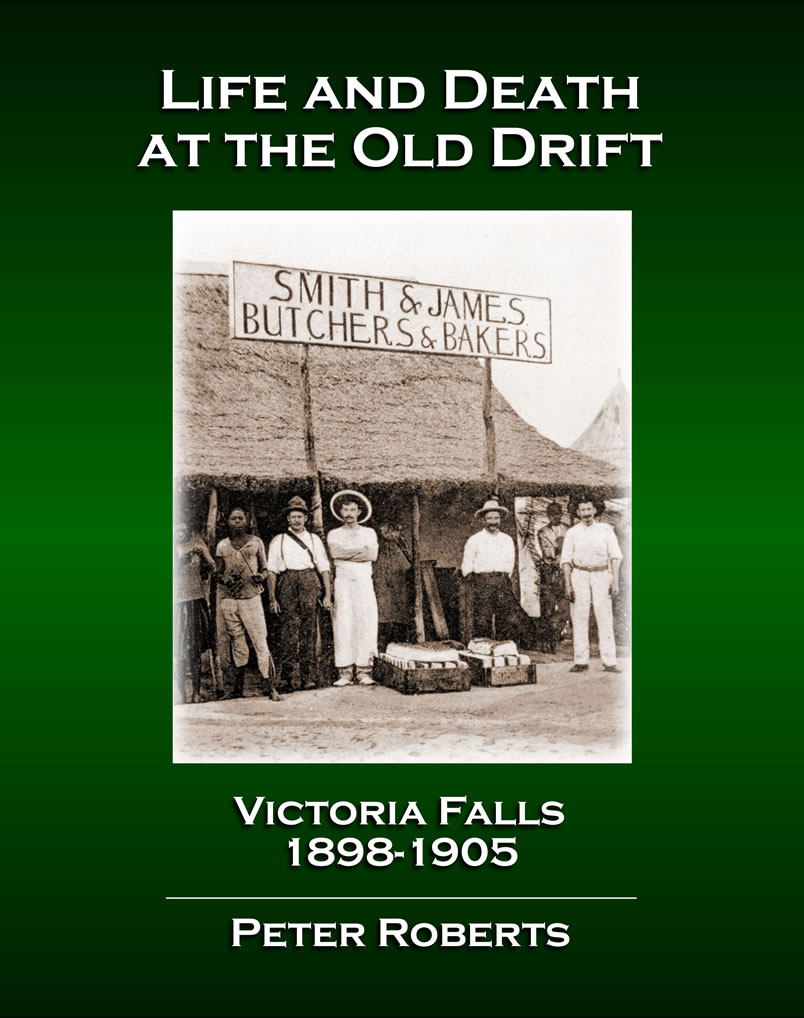
Life and Death at the Old Drift
Victoria Falls 1898-1905
The following text is adapted from 'Life and Death at the Old Drift, Victoria Falls (1898-1905)', researched and written by Peter Roberts and published in 2018 (fifth edition published November 2024 available through Amazon).
Captain Lawley Leads the Way
A significant meeting was held at the Victoria Falls on 21st June 1898 between Lewanika and Captain (later Sir) Arthur Lawley (1860-1932), the Chartered Company’s senior representative and Administrator of Matabeleland (1897-1901), further securing the Company’s control over the territory. The ‘Grand Indaba’ was arranged by Coryndon in order to reassure Lewanika of the Company’s intentions and renegotiate details of the original Lochner Concession.
“In 1898, Captain the Hon. Arthur Lawley, at that time Administrator of Matabeleland, headed a mission to King Lewanika of the Barotse, in order to obtain an accurate definition of the British South Africa Company’s rights north of the Zambesi, and to re-adjust certain conditions in the Company’s concession.” (Southern Rhodesia Publicity Office, 1938)
Lawley documented his expedition in an account published in Blackwood’s Edinburgh Magazine, December 1898.
Route to the River
To ease the passage of his convoy of wagons to the north, Lawley determined to complete the cutting of a more direct route north to the Zambezi.
"I made up my mind to complete the road which had been marked out by Mr F. Lewis at the end of 1896, and part of which had been cut by Mr Frost in 1897. This road runs from Esibombom’s old kraal on the Gwaai river north-west to the Linquazi valley, and thence across the desert country marked as ‘The Land of the Thousand Vleys’ to Thama Setchie on the old road from Palapye to Kazungulu. It was represented to have the advantages of being more direct and better watered than the regular route; moreover, by striking the old road at Thama Setchie one avoids the long stretch of black soil in the neighbourhood of Thama Sanka, which during the rainy season becomes an almost impassable sea of black mud."
Lawley hired the services of Bulawayo transport rider Mr Daniel John Tolmay to transport his supplies to the Zambezi. Tolmay, having recently married, brought his wife along on an informal ‘honeymoon’ to the Falls - the only woman in the party.
"On the 18th April Captain Jesser Coope left Bulawayo with two waggons, five mounted police, and thirty natives with instructions to cut the road through the thick bush, clear out and deepen the water-holes, and then to push on with all expedition to the river. A second party with twelve police and one waggon left under Sergeant-Major Norris, B.S.A. Police, on April 25th, and on May 3rd my own party started, consisting of my brother, Major Lawley (7th Hussars), Mr Yaldimir Gielgud (the future native Commissioner of the Sebungwe district), Mr R. A. Blanckenberg (my secretary), Dr Ellis, S. Rodger (my servant), two orderlies B.S.A. Police, fifteen Matabele boys under Sikobokobo (a Government induna of the Inyati district), and two interpreters, John Makunga and Sebakwe, a son of Mphoeng."
The Greens at Nyamandhlovo
"Two waggons and twenty horses, a Cape cart and six mules, with twelve pack -donkeys, formed my transport train. I found it impossible to start with my waggons, so I gave instructions to my Cape cart to go straight on to Nyamandhlovo, thirty miles from Bulawayo, and await my arrival there. On May 4 I left Government House at noon with my brother, Gielgud, Blanckenberg, and Rodger, and rode across the veldt to Nyamandhlovo, where I expected to find my Cape cart; but in this I was disappointed, and had it not been my good fortune to find Messrs C. and L. Green at their store at Nyamandhlovo I should have fared badly, as I had neither food nor blankets for myself and horses. We reached their house about an hour after sunset, and they immediately set to work to make every possible arrangement for our comfort, giving up to us their own hut, and making full provision for ourselves and horses.
"Next morning I sent back a native runner to find my waggons and to tell them to come on at once, but it was not until the following day that any news of them reached me. On Friday morning the 6th Gielgud arrived with the conductor of the waggons, and his report of their progress was not encouraging. Although I had eighteen oxen in each span, it had taken them two and a half days to accomplish twenty-four miles. Evidently if they were to reach the Zambezi some arrangement must be made to lighten the loads, which were certainly heavy, if not excessive. Luckily for me, Messrs Harris and Green came to the rescue with four good oxen and a light waggon, and I was able to break up my spans and go on with three waggons instead of two. I resolved to push on with my Cape cart and a few days’ provisions as far as Esibombom’s kraal, where I hoped to get a few days’ shooting and to see something of the timber forests on the Gwaai, intending to await the arrival of the waggons there. Accordingly, on the afternoon of May 6, my brother, Gielgud, and I left Nyamandhlovo on horseback, having sent on in advance my Cape cart and mules, and six Matabele boys on foot.
"We reached Menu ‘Nkoni’s kraal at six o’clock, and camped there for the night... Already we had experienced some of the delays which make waggon travelling in South Africa so exasperating and tedious, but they were nothing to those which we were to encounter later on. Already we had embarked upon, the sea of sand through which for over 250 miles we were destined to plough our way mile after mile of it choking, pitiless, and unending sand.
"Leaving Menu ‘Nkoni’s kraal at daybreak on the 7th, we trekked for twelve miles through a dense belt of forest until we reached the Insezi river, which we followed until its junction with the Gwaai... Here, and in fact throughout our journey to the river, we lived entirely on guinea-fowl and other birds : without these we should have fared ill, for we relied on our guns to keep our larder supplied, and only carried half-a-dozen pounds of tinned meats to last us for the whole journey from Bulawayo to the Zambezi."
Crossing the Gwaai
"On the morning of July 9 we crossed the Gwaai at its junction with the Insezi. At this point the Gwaai is a broad bed of sand with occasional pools of water, many of them several miles apart. This is a very feverish locality, the soil in many places rich black loam, and the vegetation rank and tropical...
"After proceeding down the western bank of the Gwaai for about six miles one wheel of the Cape cart completely collapsed. I sent back at once for the donkeys and pack-saddles, and improvised a sleigh from the forked trunk of a tree, on. which we packed the contents of the cart. Luckily the road was fairly smooth, but our sleigh made very slow progress in the heavy sand, and it took us nearly three hours to accomplish the two miles which intervened between us and the water where we intended to camp for the night.
"Here I met two Zambezi boys on their road to Bulawayo, and found that they were carrying the Barotse mail. Coryndon, writing from Kazungulu, told me of his intention to meet me with waggons and grain at either Deka or Thama Setchie, and of his having sent back word to Lewanika to meet me at the Falls ; but in his (Coryndon’s) opinion it was doubtful if the old man would undertake the journey of 400 miles from his capital to the Falls, seeing that he had not been farther than twenty miles from Lialui during the last twelve years. Coryndon strongly advised me not to attempt Lewis’s road, but I was so far on the way that I decided not to alter my plans. We were now nearly ninety miles from Bulawayo, and within three miles of Esibombom’s old kraal.
"We camped in a belt of mapane trees: their trunks, as a rule, are perfectly straight, but here they were warped and twisted into strange fantastic shapes where, as young trees, they had been torn and trampled by the elephants, which not many years ago roamed in herds over all this district. It is sad that in these contortions is the only trace remaining of these splendid beasts...
"Our sleigh reached Esibombom’s with difficulty, and there we spent two days in hunting... While here we got news of both Coope and Sergeant-Major Norris, the latter of whom after many struggles had only got as far as Huilili Vlei just ahead of us. On the second day our donkeys came in with supplies from the waggons, and the following morning we started with our pack-train...
"The country hereabouts is a dead level, the road heavy sand through thick stretches of 'magusu,' with occasional belts of open plain...
"On reaching Makololo Pan we were obliged to await the arrival of the waggons, as our supplies were running very short. There was a great deal of old spoor about, principally giraffe, blue wildebeestes, and roan antelope, which evidently frequent this district in the wet weather. While here I killed another blue wildebeeste, a particularly fine bull ; but beyond him we saw nothing but a few sable, which were very wild, and none of which we killed."
The Land of the Thousand Vleys
"On May 17 I heard from Coope at Chekwankie, which he had reached after a hard time, owing to the thickness of the bush to be cut and the scarcity of water. His report was that there was a dry stretch between Ingwershia and Chekwankie of seventy-three miles, with only one point, about halfway, where we should find water, and that in three small pans which were quickly drying up. The boys who brought the letter said that the water would not last more than five days. I thereupon decided to reduce the number of my waggons from four to two, and to send six of the police back to Bulawayo.
"Even so, it was doubtful if the water would hold out till the waggons reached the pans. Riding back, I repacked the waggons, taking only the barest necessaries, and reducing the weight on each waggon to under 3,000 Ib. I also sent back the worst of the horses and the weak and sickly bullocks. The cattle were so knocked up by their incessant struggle through the choking sand (which in many places was up to the axle-box of the waggons) that I had great difficulty in picking out two serviceable teams.
"I myself decided to push on with my pack-train to the Falls, and to send back from there fresh cattle and provisions for the men to help them out of the difficulties which I anticipated in the dry stretch that I knew lay between Thama Setchie and Deka. Had I known what their difficulties would be, I should have been inclined to send all my waggons back and taken my chance of getting through with only my mules and donkeys. I did not see the waggons again for five weeks, when they reached my camp at the Falls.
"We left the waggons in the afternoon and trekked on to a tributary of the Linquazi called Kumbulabaswi, which we reached at 10 P.M. Heavy rain had fallen here, the night was bitterly cold, and all our party were very tired.
"Leaving at dawn on the 20th, we reached Ingwershia about 10 A.M., where we found a large vlei of good water. Beside this stood a deserted waggon belonging to Peebles and Scott, two prospectors whose donkeys had all been taken by lions last year...
"Leaving Ingwershia at 3 P.M., we trekked on till about 10.30, and camped for the night. The boys were very tired, and we had great trouble in keeping them moving ; in fact we only got about twelve miles from Ingwershia in nearly seven hours."
"From day to day our march was most uneventful and monotonous. Every morning we were off at sunrise, stopping at midday to cook and eat the guinea - fowls or pheasants that we shot on the road, resting to graze our animals, and moving on again about 3 or 4 P.M. to trek, as a rule, well into the night...
"Each night our camp was laid out with the greatest care to protect our animals from the lions and wolves with which the country is infested. The mules and horses were tethered to a clump of trees. Close around them our party was disposed in five little groups, each in its own ‘scherm’ with an outer ring of fires, which were kept burning briskly through the night till the sun had risen and camp been struck."
At Thama Setchie
"Thama Setchie, though marked on every map of Africa, has nothing to distinguish it from the barren veldt which stretches for miles on every side, except a few small holes dug in the sand to indicate the only permanent water-supply of the place. These had to be deepened and cleaned out before we could get enough water for even our small number of men and animals. If this northern route is to be opened up wells will have to be sunk here and elsewhere, and a man put in charge to keep them in order and regulate the traffic. At present the supply at Thama Setchie is exhausted by two spans in a very short space of time.
"From Thama Setchie to Deka, a distance of over fifty miles, we only found one supply of muddy water at Henry’s Vlei, twenty miles north of Thama Setchie, and this was completely dried up before our waggons reached the spot."
The Game and the Fly
"The sand here is indescribably deep and heavy, and this is the worst part of the abominable road from Nyamandhlovo to Deka. It is difficult to exaggerate the dreary monotony of the country, mile after mile of flat white sand covered with interminable scrub, and only occasional breaks in the way of grass- covered vleis or glades. The size and number of the large timber trees was sadly disappointing, and anything approaching a really fine tree was rare. The only sign of life was an occasional Bushman’s kraal (in every case deserted).
"There was but little spoor of big game, and only a very rare glimpse of a buck. Luckily guinea-fowl and pheasants, especially the former, were very plentiful, and from the time we left Bulawayo until we reached the Zambezi we only once had recourse to tinned meat.
"At Deka the country is quite different in character from that through which we had been passing. Here we got on to formation and crossed a lot of broken country and rocky kopjes covered with low scrub. The Deka river, on which we camped, was full of beautiful water, and from this its head-water to its junction with the Zambezi the valley is well watered and fertile.
"About two miles from our camp I found the deserted huts of a white man in which were many fine specimens of various kinds of heads eland, koodoo, sable, tsessebe, water-buck, etc., all worm-eaten and decayed. Before the rinderpest this neighbourhood was wonderfully rich in all sorts of game, which seemed to have suffered more here from the plague than in any other part of Matabeleland.
"The buffalo have entirely disappeared, the koodoo (formerly very plentiful) are almost extinct, and the other varieties have suffered severely, especially the wild pig.
"I afterwards learnt from the Barotse that before the Basuto invasion this district was thickly inhabited and rich in cattle. The tsetse fly was not then known between Deka and the Gwaai to the east, and Deka and the Zambezi to the north. After their invasion the natives were either killed by alternate raids from the Barotse and Matabele or else they moved elsewhere, taking their cattle with them.
"Then the game returned, and with the game came the tsetse fly. Two years ago the fly were very numerous, and the country east of the Pandamatenka road was on this account impassable for cattle and mules. Now that the game has been almost exterminated by rinderpest, the fly also has left the country excepting a few belts of thick bush, and apparently it is gradually disappearing. All of which goes, in my opinion, to prove that the tsetse fly moves with the big game of the country, and that with the latter it is bound to disappear before the advance of civilisation."
At Pandamatenga
After a difficult journey Lawley and part of his convoy met with Captain Jesser-Coope at the old Pandamatenga trading post, before continuing on to the Falls.
"Pandamatenka, which we reached next morning, is well watered and fertile; but the water is not wholesome, and the whole place is very unhealthy and feverish. At one time a small white colony was established here... but the only inhabitant now is a colonial boy named Nicholas Villiers, otherwise ‘Klaas,’ who is the last survivor of the Westbeech colony, nearly every member of which is buried in the little cemetery by the river. The Jesuits built substantial huts, but they are all deserted and falling to ruins, which only add to the forlorn look of the station generally. From Klaas, who was very ill, I learnt that Coryndon had met Coope here and gone on with him to the Falls."
From Pandamatenga Lawley travelled on to the Falls, crossing the headwaters of te Matetsi River and travelling along its north bank before cutting north to the river. Lawley does not give a day by day account but this part of the journey, covering approximately 50 miles (75km) and which probably took 4 or 5 days. Lawley arrived at the south bank on the 1st June 1898, where Coryndon had prepared his camp close to the local landmark of the 'Big Tree,' the large baobab tree (Adansonia digitata), located a couple of kilometres upstream of the Falls (and still standing to this day).
"On the second morning after leaving this dreary spot we suddenly came to the crown of a hill from which we got a lovely view of the Matetsi river running through wooded hills away to the north-east, and about twenty miles away we saw what at first appeared to be a small white cloud, but was really the spray rising in one great volume from the Victoria Falls. About five miles on we stopped for breakfast, and on climbing to the top of a little kopje we could hear the dull thunder of the river, which at this distance sounded like the faint boom of a distant threshing machine.
"At 4.30 we came within nearer sight and sound of the Falls, and at six o’clock reached Coryndon’s camp on the edge of the Zambezi. It was a great satisfaction to find myself at my journey’s end on the very day (June 1) on which three months before I had written and told Coryndon to expect me at the Falls. The animals and the boys were all very much knocked up, but it had been impossible to rest on the road. As it was, the boys had been on short rations the whole way, and when we got to the river we had exhausted all our supplies except a few handfuls of flour and a little tea."
At the Falls camp Lawley met Mr F Lewis, freshly returned from the Kafue region.
"At Coryndon’s camp I met Mr F. Lewis, who had just returned from a lengthy tour through the Batoka and Mashukulumbwe country. Learning that the king was at Shesheke and could not reach the Falls for ten or twelve days, and knowing that my waggons were a long way back, I determined to cross the Zambezi to a point on the Nquezi river about seventy miles north of the Falls, where Mr Lewis had had his camp while prospecting that district, and where he assured me we should find game of all sorts in abundance."
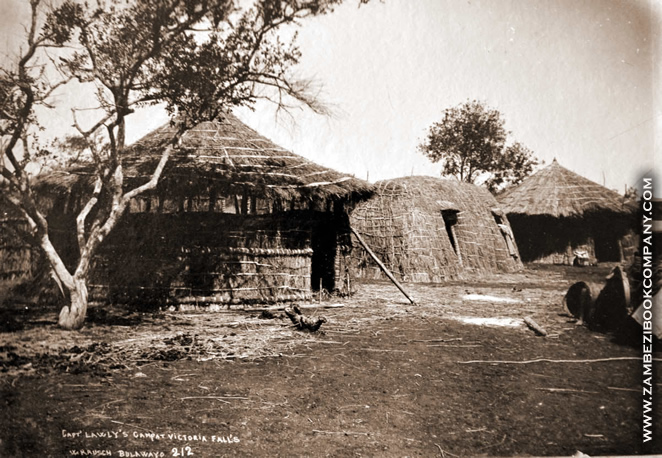
Captain Lawley's south-bank camp at the Victoria Falls, photographed by William Rausch who arrived at the Falls in late June/early July 1898.
A Visit to the Falls
"Having made all preliminary arrangements for our trip, we... then we set out for the Falls and spent the rest of the day examining them from all points. They have been described so fully by various writers that I will not attempt any elaborate description of their beauty. I will only say that they are in a measure disappointing, for the spray in which the greater part of them is always enveloped is so thick that a great deal of their form and beauty has to be left to the imagination.
"Here and there I could see a great volume of water hurling itself into the abyss in itself a beautiful cascade, but only a tiny portion of the mighty mass which for a mile in width is for ever rolling over a wall of rock and falling to a depth of 400 feet into the seething chasm below.
"From the chasm itself a dense cloud of spray perpetually rises and hangs like a white curtain above the great cleft of rock into which the waters fall ; around and about the curtain the sunlight is reflected in a thousand flashes of brilliant prismatic colours, and rainbow chases rainbow through the shifting sheets of mist. The roar from the falling waters is deafening, and the whole effect is very grand and very weird...
"Above the Falls the river is nearly two miles in width, and is dotted with numerous islands covered with palm-trees and other tropical vegetation...
"The following morning I crossed the river to see the camp which was being built for the king on the northern bank. It was a lovely morning, and the views from the boat as we slowly rowed from island to island were enchanting in their constant variety of perfect beauty. It was a veritable glimpse of fairyland.
"We spent some hours in rowing about the river and visiting the king’s camp, returning about 2.30 to find the two Zambezi boys whom we had met at Esibombom’s kraal, and who had gone to Bulawayo and returned with our English mail.
"We hurried through our letters from home, and then walked up the river -bank three miles to Sekute’s ferry, where we had to cross our party by detachments in the one canoe at our disposal. I cannot describe the beauty of the river seen at the moment that we crossed. At this point the river runs east and west, and as we slowly glided over the water we had on our left the golden glory of the sunset and on our right the silver splendour of the moonrise. The perfect stillness was only broken by the regular plash of the paddles, and from time to time by the distant bellow of a hippo bull. The night was cold, but we got our carriers under weigh in the grey dawn, though we had some difficulty in inducing the shivering wretches to leave their fires. But by six o’clock the camp was deserted and the line of march formed."
After the short diversion north for some hunting, Lawley returned to the Falls on the 16th June.
"We reached Coryndon’s camp on the evening of the 16th. On my way back I found three white men lying sick and helpless on the veldt outside Sekute’s kraal. They belonged to a party of six who left Bulawayo in January with the idea of trading in Barotseland. They reached the river after three months of great hardship, arriving with no European food, and all more or less prostrate with fever. Their three companions had gone on into the Mashukulumbwe country while they remained by the river.
"For two months they had lain there, and had it not been for our arrival with decent food, must have died of starvation. Their experience is by no means unique, but it is impossible to extinguish the ‘exploring’ spirit that drives men to the north in search of adventure involving certainly privations and frequently death. I sent my canoe back to bring these men across to my camp, and they were sufficiently recovered by the end of the month to leave with my waggons for Bulawayo, though I regret to say that one of them died on the road. On returning we heard that the king was due on the following day, accompanied by Coryndon, who had gone to meet him at Kazungula."
Lawley's published account makes no further reference to these men (see The 'Group of Six', below, for more information)
Victoria Falls Indaba
Lewanika’s temporary royal court was prepared for him on the north bank close to the confluence of the Maramba River with the Zambezi. Contemporary sources recorded that the Litunga’s retinue of officials, advisors and assistants included over a thousand men.
"The king’s arrival at his camp the next day was made known to us by a general outburst of shouts and songs, and a beating of drums and tom-toms, which was kept up until midnight. The king brought with him his son Letia, who has adopted the Christian faith, and his chief councillors. His retinue included a band, in which the drums played a most conspicuous part, choristers, dancers, and about a thousand followers. The female element was entirely omitted. His having undertaken the (to him) unprecedented journey of 400 miles [644 km] at my bidding was regarded by the whole nation as an event of the greatest importance. The younger of the councillors were very averse to it, as they regarded it as an act of homage to the white man, whose growing ascendancy with the king they look on with disfavour. So, too, when the question arose as to whether the king should first call on me or vice versa, they were strongly opposed to his losing (as they considered it) his prestige by being the first to come and pay his respects. But upon this I insisted."
Lawley received Lewanika at his camp on the south bank on the 20th June 1898.
"My waggons having arrived on the 18th, I received the king in state on the 20th. The thirty Matabele boys having spent the morning in sweeping up the camp, were drawn up as a guard of honour facing the entrance to my camp. This consisted of a row of neat huts built with poles and grass laced with stripes of palmleaf, the whole being surrounded with a reed fence about nine feet [2.7 m] high, in which were neatly made doorways south, east, and west.
"With the small number of canoes at his disposal the king was only able to bring a small part of his retinue. The councillors and his band having preceded him across the river, awaited his arrival at Coryndon’s camp (which was situated about 300 yards [274 m] from my own), at the landing stage of which the B.S.A. Police, fourteen in number, were drawn up as a guard of honour. The king’s arrival about 10.30 was announced by the band striking up, and a general chorus of ‘Yosho’ from the expectant councillors while the guard presented arms. The guard of honour then formed the advance guard, and, followed by the band, preceded the king, accompanied by Major Coryndon and his suite, to the eastern entrance of my camp, where I met him, and after shaking hands conducted him to my hut. The king’s costume was rather remarkable. On his head he wore a black broad-brimmed felt hat over a scarlet night-cap. A long bright blue dressing- gown much embroidered with scarlet braid in Manchester style, a flannel shirt, tweed waistcoat, trousers, and aggressively new yellow boots, completed his costume. This was evidently his holiday attire, for on other days his scarlet nightcap was replaced by a blue Tam-o’-Shanter, and the dressing-gown by a shoddy ulster [overcoat]."
Lawley and his men had transported from Bulawayo an iron barge, separated into sections, which was then assembled on the riverside.
"After an hour or more we walked down to the river to inspect the big boat which I had brought up with me, which was then in course of construction. The king and his son, who is a clever carpenter thanks to the instructions of the French Protestant missionaries at Kazungula took the greatest interest in the tools of our carpenters as well as in the boat itself. Then followed the inevitable photograph, and the king departed as he had come."
Sadly no photographs fom the expedition are yet known. The following day Lawley was accordingly received by Lewanika on the north bank.
"My return visit to the king was made the occasion of a great reception by the king and his people. We crossed in several canoes, and on arriving at the landing-stage were met by Letia and some of the chief councillors. A wide path had been cleared from the river-edge to the king’s kothla or council chamber, and on either side were crowded various detachments of Barotse, who as we passed greeted Letia with a loud and prolonged chorus of ‘Yosho,’ a salute only offered to royalty, accompanied by hand-clapping and constant prostration of the body to the ground. The king’s camp consisted of groups of long huts divided and surrounded by a high reed fence, and the whole of the camp was floored with a smooth even surface of sun-dried clay, and kept scrupulously clean swept and garnished...
"The following day we again repaired to the king’s camp and continued our discussion about the new concession, the king and his councillors entering into every detail, and discussing every point backwards and forwards. We came back to our standing camp about four o’clock, and the following day I again visited the king, hoping to conclude my business with him and his people. Twelve o’clock came, and we had yet much to discuss; so as the king was to come to lunch, and we intended to have a gymkhana meeting in the afternoon, I postponed the final settlement till the next day. Returning to my camp, we had to wait two and a half hours for his majesty, who arrived at 3.30 instead of one o’clock, so that I put off the sports till the following day, on the morning of which I finally settled all points at issue. The whole of the new concession had been read and interpreted clause by clause to the king and his people, who expressed themselves perfectly satisfied with its terms.
"That afternoon we held the first meeting of the Victoria Falls Turf Club under the patronage of the Royal Family of Barotseland. Coryndon and Coope had laid out a small course and organised an excellent programme. The royal stand consisted of a buck-waggon covered with chairs on which sat the king, Letia, the Gambella [Prime Minister], and other members of the court. Nothing could have been more successful, and the king was hugely delighted with the fun. A bending race, steeplechase, V.C. race, postilion race, and several foot-races formed the various events.
"The foot-race for natives was most amusing. There were nearly a hundred competitors all in the wildest state of excitement. The Barotse, I regret to say, completely defeated the Matabele; but Sikobokobo, my induna, gravely informed me that this was only because I had fed the Matabeles so much better than the king fed the Barotse that they were far too fat to run...
"In the evening all the police came to my camp for a ‘Singsong’ round a huge wood-fire, and it was nearly midnight when the National Anthem rang out over the waters of the Upper Zambezi." (Lawley, 1898)
Return to Bulawayo
The Bulawayo Chronicle closely the progress of Lawley’s expedition, which returned to Bulawayo by the end of July.
"The return journey was made via Wankie’s new kraal, which is about sixty miles south of the river, thence to the Shangani and Bembesi, on to Bulawayo. Capt Lawley was only twenty-four days on the journey from the Victoria Falls to town." (Bulawayo Chronicle, 30th July 1898)
The 'Group of Six'
An interview with Captain Lawley recorded that he had rescued a total of five men stranded on the Zambezi.
"As showing the folly of men going up to the country unless remarkably well equipped, Captain Lawley’s party picked up five white men in the last stage of destitution, and who must have perished had not the party found them... Two of these men had been lying outside a kafir kraal on their backs for two months, and had been fed by the natives. There is really nothing to draw men up to that part." (Bulawayo Chronicle, 30th July 1898)
A report published a week early indicated that 'four or five' men had receieved treatment at the Bulawayo Hospital after being 'picked up in different parts of the counrty.'
"Repeated warnings have been given of the danger, not merely to health, but to life itself, incurred by persons undertaking the trip to the Zambesi without sufficient resources or knowledge of the country. The warning may again be repeated, however, and as an object lesson it may be stated that within the last few months some four or five men have been brought into the hospital, who were picked up in different parts of the country on their way up, fever-stricken and utterly destitute, and brought into the Hospital raving in delirium. A great number of prospectors and traders seem to go up with the idea of there being an El Dorado awaiting them on the banks of the Zambesi, and when they do get there, if they are lucky enough to do so, find they have been mistaken. Of course there is nothing to prevent men properly equipped, and with some knowledge of the country from going up; it is against the dangers attendant on ignorance and inexperience that a warning is urgently needed." (Bulawayo Chronicle, 23rd July 1898)
In his account Lawley indicates that a party of six men had left Bulawayo in January 1898 for the Zambezi, and that the three men found at Sekute's on the north bank of the river were from this party. He indicates the other three the men had gone on to trade north of the river. One of the three men found at Sekuti's died on the return journey, leaving five men from this party - and possibly the same five men rescued by Lawley and the same 'four or five' men who end up being treated the Hospital (or at least some of them).
The names of these men are currently unknown, but it is believed that the man who died is likely to have been John Hay Manson, whose death record indicates he died on 5th July 1898 'near Victoria Falls.' The only other detail recorded is that he was trader, although the record of his death does not appear to have been officially registered until 13th June 1899, the record being signed 'G N Thackwray, Controller.' (Manson, 2024).
John Hay Manson was born in Scotland on 3rd February 1876 and arrived in Natal in early 1897. After making his way via Pietermaritzburg he appears to have reached Bulawayo towards the end of the year, obtaining a prospecting license (no. 19612, dated 22nd November 1897). After this details of his story are currently unknown up to his death.
Lawley records after discovering the three men at Sekute's on 16th June that they recouperated at his south-bank camp and "were sufficiently recovered by the end of the month to leave with my waggons for Bulawayo" (June).
Assuming the group left at the end of the month as Lawley states, Manson's recorded date of death would place them five days from the Falls, by which time they would have probably reached the area of the headwater tributaries of the Matetsi River, Pandamatenga station itself or a day's journey beyond, depending on their rate of travel.
The Pandamatenga trading station was established by George Westbeech in the early 1870s as a staging post to the Zambezi and beyond, located on what is now known as the 'Old Hunter's Road' (forming the modern day border between Botswana and Zimbabwe). A small graveyard is known to be the last resting place five known individuals.
"Pinto gives the names of five people buried at Pandamatenga at that time. Jolly, who was a hunter and trader; Frank Cowley who was a young Englishman; Robert Bairn who was one of Westbeech's traders, as far as is known, or his storekeeper; Baldwin, who incidentally was a Cambridge wrangler - funny place for him to die - but he was a brother of the famous hunter and he died there of fever. And then Walter Carey Lowe, another man buried there who was just an elderly tourist. I've just fenced those graves in and tidied them up - they are now a National Monument." (Hepburn, 1973)
This information, however, was recorded by Pinto in 1878. More recent information indicates that there are at least 23 graves at the old Pandamatenga cemetery.
By 1898 increasing numbers of Europeans were travelling north of the river, many of them members of the Captain Drury's party of British South Africa Police sent to establish a station at Monze (together with a handful of settlers), as well as members of Captain (later Lieutenant-Colonel) Alfred St Hill Gibbons' expedition and the recorded comings and goings of various missionaries (Sampson, 1956).
In addition two parties of hunters/traders are known to have travelled north of the river in 1898. Mackenzie and Timmins, who returned safely in November (Bulawayo Chronicle, 5th Nov 1898), and Going, Gordon and Mr Clarke Jervoise, who travelled from Francistown on behalf of Messrs Loosley and McLaren, traders based in Palapye and Bulawayo (Bulawayo Chronicle, 1st Oct 1898). Both parties visited Barotseland. The 'group of six' recroded by Lawley therefore appear to be an additional, as yet unidentified party.
Frank Acutt and Fred Crewe are also known to have been in Barotseland in 1898 recruiting labour for the newly opened mines at Sebakwe.
"Native Labour - On Tuesday afternoon Messrs Acutt & Crewe received a batch of 150 Zambesis, whose appearance here is another fruit of Mr Fred Crewe’s labours. The boys left town yesterday afternoon, the majority of them being destined for the Globe and Phoenix Mine, Sebakwe." (Bulawayo Chronicle, 10th September 1898)
The Lawley Concession
Despite the efforts and negotiations, Lewanika did not sign the Lawley Concession, make a late request for the reservation of the Barotse heartlands to remain a special reserve under his authority and excluded from the Company’s mining and settlement rights.
It fell to Coryndon to conclude the negotiations and get the Barotse Litunga to sign pen to paper. Known as the Lawley Concession, the treaty negotiated by Lawley was not formally agreed until October 1900, together with an additional Concession signed by Lewanika and Coryndon (now Administrator of North-Western Rhodesia).
"New and final Concessions with Lewanika comprising the Lawley Concession and the Coryndon Concession were both signed by Lewanika and the British South Africa Chartered Company on 17th October 1900. The British Government approved the Lawley Concession as Concession ‘A’ on 8th August 1901, and the Coryndon Concession as Concession ’B’ on 23rd November 1901." (Bull, 2014)
References
Bulawayo Chronicle (23rd July 1898) The Zambesi Trip - Another Warning, 23rd July.
Bulawayo Chronicle (30th July 1898) Captain Lawley Interviewed - His Trip to Barotzeland.
Bulawayo Chronicle (10th September 1898) Native Labour.
Bulawayo Chronicle (1st Oct 1898) A Trading Expedition into Barotseland
Bulawayo Chronicle (5th Nov 1898) Curios from Barotzeland.
Bull, Mutumba Mainga (2014) Reserved Area: Barotseland of the 1964 Agreement. Zambia Social Science Journal, Vol.5, No.1.
Hepburn, E. T. (1973) European Pre-pioneers, 1500-1890. Rhodesiana, No.29. December 1973.
Lawley, A. L. (1898) From Bulawayo to the Victoria Falls: A Mission to King Lewanika. Blackwood’s Edinburgh Magazine, Vol.164 December 1898, p.739-759, William Blackwood & Sons, Edinburgh. Download here (Note large file: 61mb).
Manson, S (2024) Personal communications with author, July 2024.
Sampson, R. (1956) They Came to Northern Rhodesia. Government Printers, Lusaka. Download here (3.2mb).
Southern Rhodesia Publicity Office (1938) The Victoria Falls of Southern Rhodesia. Government Stationery Office.
- Go back to the Old Drift feature section index.