Life and Death at the Old Drift
Victoria Falls 1898-1905
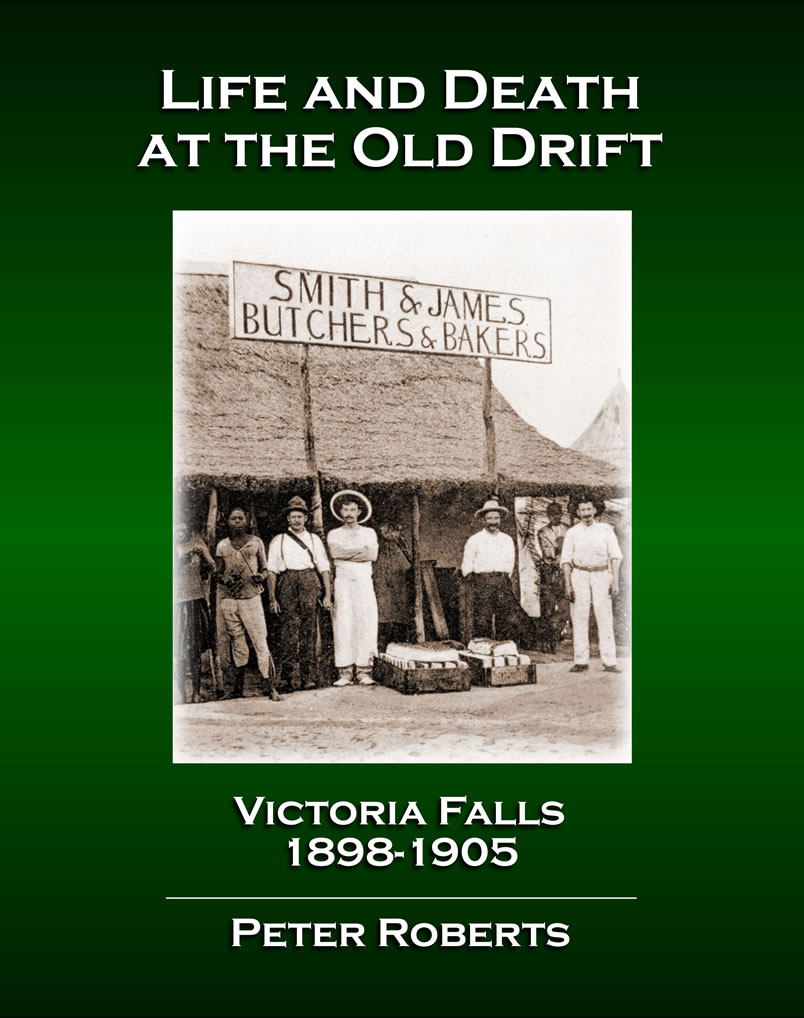
The following text is adapted and expaned from 'Life and Death at the Old Drift, Victoria Falls (1898-1905)', researched and written by Peter Roberts and published in 2018 (fifth edition published November 2024 available through Amazon).
Leopold Frank Moore
Leopold (later Sir) Frank Moore (1868-1945) was born London, England in 1868. In the early 1890 he trained and qualified as pharmaceutical chemist by 1892 had emigrated to the Cape.
“Another of these old timers was Leopold Frank Moore , a Londoner who struggled for his education in night classes until he finally qualified as a chemist; in 1892, at the age of twenty-four, Moore joined the Cape Town Branch of Lennon Ltd, but a year [or two] later went to Mafeking where he set up a chemist’s shop.” (Gann, 1964, p.138)
Moore had relocated to Mafeking by 1894 where he married Katherine Maud. The couple relocated to Bulawayo during 1896.
Moore & Co, Bulawayo (1898)
In Bulawayo Moore went into business with his brother-in-law, establishing a dispensing pharmacy in Abercorn Street by 1898.
“In 1898 he went into business with his brother-in-law at Bulawayo.” (Gann, 1964, p.138)
Also in 1898 Moore became a founding member (and first Chairman) of the Pharmaceutical Society of Rhodesia in Bulawayo with six founder members (namely Mr. H. W. Smart, Mr. W. D. Copley (first Secretary), Mr. C. F. Conrath, Mr. C. Cattel and Mr. Scott). Moore soon-after became President of the Society.
By late 1899 the business is described as a ‘dispensing and photographic chemist’ and had expanded to include ‘photographic materials’ among other items.
From early 1901 Moore was placing regular adverts in the Bulawayo Chronicle under the name of Moore & Co, Chemists, suppliers of mineral waters, perfumery and photo appliances from Bulawayo and Main Street, Gwelo.
From 1901 Moore found himself in a prolonged dispute with the Administration over plans to import Chinese labour for the mines, which he opposed.
“[Moore]... took a prominent part in the campaign against the introduction of Chinese labour, earning bitter hostility from the Chartered Company.” (Gann, 1964, p.138)
As a result he claimed his business was boycott by the Company and in 1903 he was declared bankrupt. In 1903 Moore was an unsuccessful candidate in elections to the Southern Rhodesian Legislative Council.
Deciding a fresh start was needed he and his young wife headed north to the Falls.
At the Drift (1904)
Moore and his wife relocated to the Old Drift settlement a short-distance upstream of the Falls, now also known as the Livingstone Drift, in mid-1904.
“He travelled by the Zeederberg coach as far as Dale’s Kopje, where the passengers changed to another coach which took them to the Drift. There they crossed the Zambesi in barges manned by Africans but operated by Mr Carter, an engineer in the employ of ‘Mopani’ Clarke. The crossing cost one shilling either way and ‘Mopani’ Clarke paid the Government £3 a year for his licence to use the barges.” (Gefland, 1961)
Arriving on the north bank Moore took over the vacant role of chemist - the fourth to set up business in as many years. Mrs Moore later penned a short article entitled ‘Pioneering by a Woman,’ recording their arrival at the Drift:
“He had put up a wood and iron store; I can always laugh when I think of him building it and the shape he got it into - it was square and you could see three sides at once. Then it fell down, while he was on top.” (Watt, undated)
Leopold Moore recorded that despite the hardships the Old Drift was ‘a lively spot at times.’
From September 1904 Moore placed a regular advert in the Bulawayo Chronicle:
“Visitors to the Victoria Falls should note that there is an Up-to-Date Chemist’s Shop at Livingstone. Well-assorted stocks of the following lines are kept: Photographic sundries, Kodak films and plates, all sizes. Photos of the Falls, Picture Post Cards. Books, Periodicals and Newspapers. Cigarettes and Tobaccos, Confectionary. Selected Curios and Souvenirs. Prescriptions carefully dispensed. Orders by mail or messenger receive prompt attention. L F Moore, Dispensing and Photographic Chemist, Livingstone.” (Bulawayo Chronicle, 10th September 1904)
In late April 1905 Moore placed an advert in the Bulawayo Chronicle notifying customers he would be relocating to the new township on the higher sandbelt away from the river, from 1st May.
“L F Moore, Dispensing and Photographic Chemist, Livingstone... Begs to inform his friends and customers that on May 1st he will remove to larger and more convenient premises in the New Township. Kodak Films, Prints, and all Photographic Accessories stocked. Dark Room - Films & Plates developed. Photographs and Picture Post Cards.” (Bulawayo Chronicle, 22nd April 1905)
The following month Moore reported that the lack of potential business had made him temporarily suspend the move from the Old Drift.
“I have already erected buildings at Sandbelt, but do not now intend to move there. At one time it seemed the only alternative to leaving the country. I want to do business, but there is none to be done at the Sandbelt.” (Bulawayo Chronicle, 13th May 1905)
Early November saw the residents of the Drift finally resigned to the move and rapidly establishing premises at the new township.
“Things are settling down in the new town, and most of the people are leaving the Drift. Messrs F J Clarke, L Moore and G Smith are putting up buildings as quickly as possible.” (Bulawayo Chronicle, 4th November 1905)
Moore, along with many of the Old Drift community, finally moved to the new township of Livingstone by January 1906, although many were unhappy with the new site for the township.
Located next to the Standard Bank on Mainway, Moore’s business was the only dispensing chemist in N.W.Rhodesia for many years, and the business still trades under this name to this day, although under different ownership, now relocated to Zambezi Street (Empire Street as it was then called).
The Livingstone Mail (1906)
Moore founded the Livingstone Mail in March 1906, three months after William Trayner had officially launched the rather informal Livingstone Pioneer and Advertiser. Six months later Trayner published his final issue.
“Leopold Moore did not take kindly to the Pioneer and on 31st March 1906 he started a rival weekly newspaper, the Livingstone Mail. It was typewritten on wax stencils and produced on foolscrap duplicating paper in purple ink. While concentrating on local settler news and views it contained a modicum of international matter: the first issue included the winner of the 1906 Grand National, run seven days previously...
“The Livingstone Mail survived for sixty years and is a valuable source of information on the history of the town and country, particularly from the settler point of view.” (Phillipson, 1975)
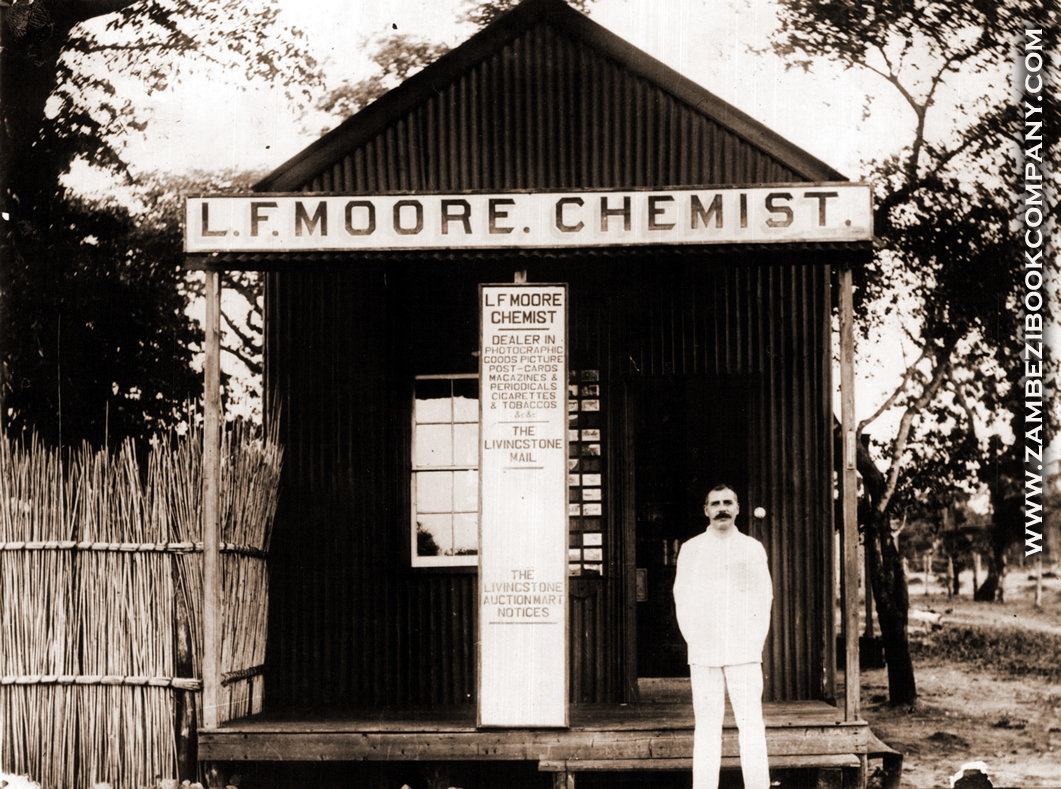
Moore outside his chemist store at Livingstone (note the postcards displayed for sale and partially hidden behind the verticle sign which reads: ‘L F Moore, Chemist. Dealer in Photographic Goods, Picture Post Cards...’The Livingstone Mail... The Livingstone Auctionmart Notices.’ Published in Gelfand, 1961, captioned ‘L F Moore’s Chemist Shop at Livingstone, about 1907’ (credited to National Archives of Rhodesia and Nyasaland). Also published in Gann, 1958 (no date indicated).
Moore documented the steady yet slow growth of the new settlement in the pages of the Livingstone Mail, often filling spare space with adverts and notices on his own varied services, including acting as authorised auctioneer, and announcing the latest stocks of cigars, cigarettes, tobaccos and pipes, consignments of ladies soaps or latest gramophone records or books from London.
Adverts from the Livingstone Mail 29th Sept 1906 included:
“L F Moore
Dispensing & Photographic Chemist, Mainway, Livingstone.
Agent for ‘The Gramophone & Typewriter Ltd’
The ‘Victor’ and ‘Monarch Junior’ Gramophones from £15 15s to £7 15s.
Records 6s each.
Dealer in
Photographic goods, newspapers and periodicals, watches and silverware,
Cadbury’s chocolate, stationery
Patent Medicines, Proprietary Articles, Toilet Requisites,
Surgical Appliances, Dutch medicines
Cigarettes and Tobaccos, Photo Postcards, ‘Kodak’ Cameras and Films,
B W & Co’s Tabloids, Sponges etc etc
L F Moore, Chemist, Livingstone.
“For violin and banjo strings – L F Moore”
“If you want a good pipe, sound Transvaal tobacco, or the latest line in cigarettes go to L F Moore.”
“L F Moore
Licensed Auctioneer, Estate & General Agent
Sworn Appraiser to the High Court N W R and to the Administrator’s Office.
Livingstone, PO Box 5” (Livingstone Mail, 29th September 1906a)
Moore was also a photographer and from August 1904 regularly produced postcards of local Livingstone events and scenes, including the Zambezi Regatta and official opening of the Victoria Falls Bridge in 1905. In the Livingstone Mail of 29th December 1906 issue Moore announced the sale of postcards from the Christmas Sports day, held the week previously.
“Photo Post-Cards of the Christmas Sports are now ready, price 6d each. L F Moore Chemist, Mainway.” (Livingstone Mail, 29th December 1906)
Moore became known for his hosting of gramophone concerts, promotions for his latest stock of musical records from England.
“Our pleasures were simple in those days. Mr L F Moore (afterwards Sir Leopold Moore), who owned the chemist shop and who published the first paper in Northern Rhodesia, The Livingstone Mail, used to give gramophone concerts each week with the latest records from England on the old fashioned trumpet gramophone.” (Hunt, 1959)
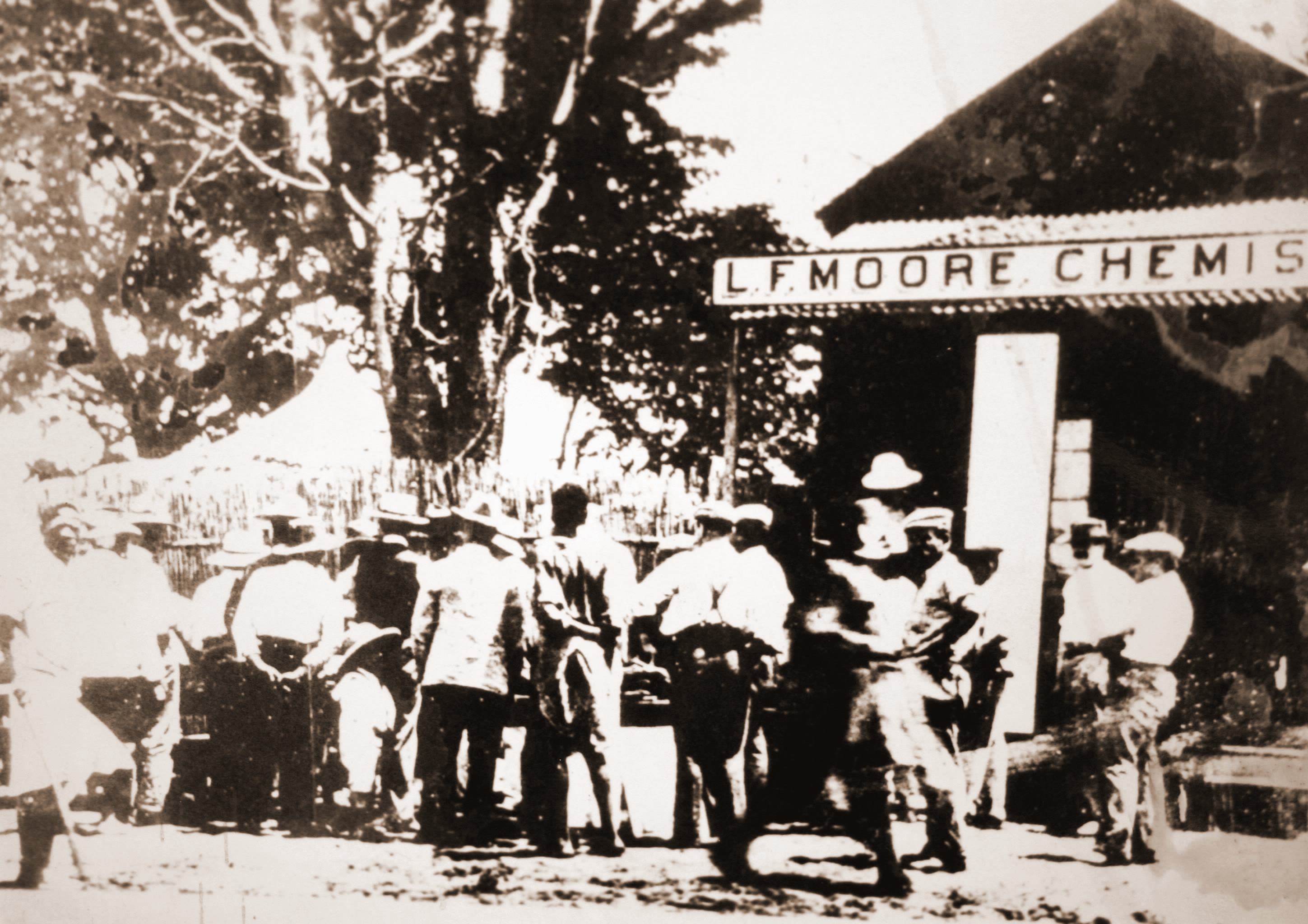
L F Moore, Chemist (Mainway). Published in Phillipson, 1975 (p.92), captioned ‘An auction conducted by Leopold Moore in front of his chemist’s shop at the Old Drift.’
Moore also initiated a lending library for the growing community, again importing the latest titles from the home country.
“In 1906 Leopold Moore organised a lending library. Within three years it had accumulated some two hundred books, which were housed in the Court House.” (Phillipson, 1990)
Moore initially used a Roneo printer to reproduce the Livingstone Mail, early issues of which were often just one-double sided foolscap sheet printed in purple ink, but in August 1908 Moore imported a ‘cropper’ printing press and continued to use that machine, which involved hand-setting and re-distributing type after printing, until 1911, when he converted to a Typograph.
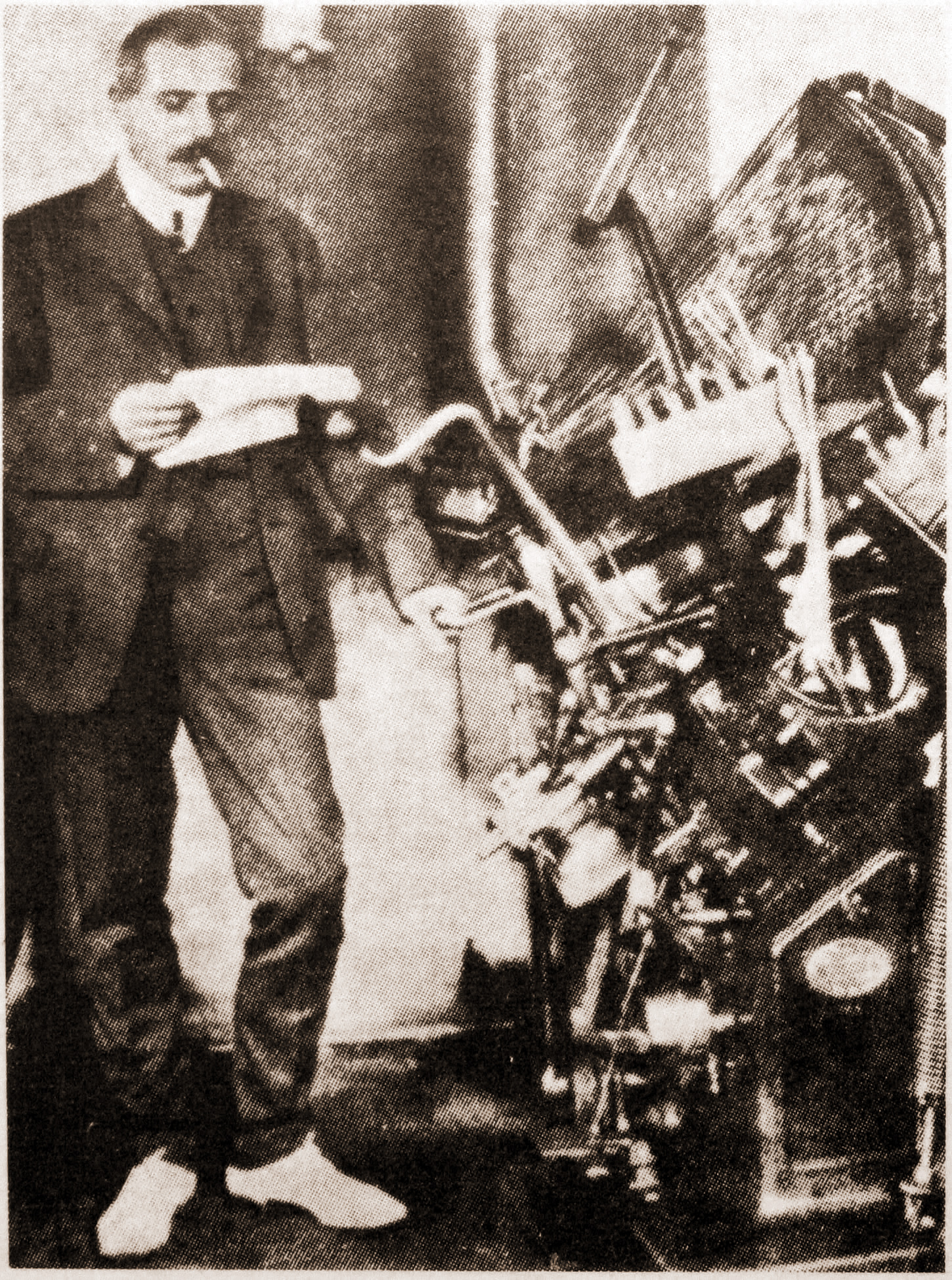
Leopold Moore with his first printing press (from Phillipson, 1975, p.99)
“By May 1908 its circulation had risen to one hundred and seventy-five copies. In October of the previous year Moore had run into trouble: it was so hot that the wax on the duplicating stencils melted on the typewriter. Nothing daunted, he ordered a printing press which was installed in August 1908.” (Phillipson, 1975)
Later Life
From 1918 Moore was an elected member of the Northern Rhodesia Advisory Council, and successfully campaigned against amalgamation with Southern Rhodesia in a referendum held in 1922 following the end of the Chartered Company’s Administration north and south of the river. (The proposal was rejected by 82 percent of voters, who voted in favour of the territory becoming a Crown colony with a Legislative Council.)
In 1924 Moore was elected to the Northern Rhodesia Legislative Council, representing Livingstone residents for 17 years.
Moore was knighted in 1937 and died on 15th May 1945 in Livingstone.
Postacrds
A group of postcards attributed to L F Moore are available on the To the Victoria Falls website.
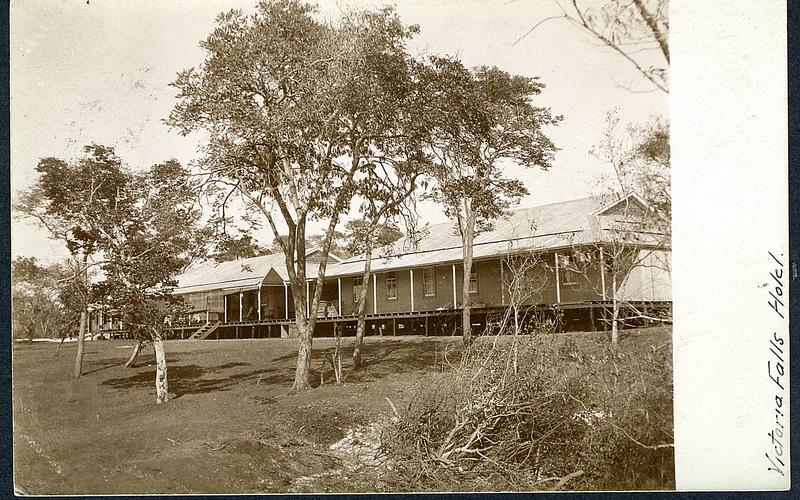
The Victoria Falls Hotel, from a postcard published by L F Moore
References
Bulawayo Chronicle (11th June 1898) Advert, Moore & Co.
Bulawayo Chronicle (25th November 1899) Advert, Moore & Co.
Bulawayo Chronicle (6th February 1901) Advert, Moore & Co.
Bulawayo Chronicle (10th September 1904) Advert, L F Moore, Chemist.
Bulawayo Chronicle (22nd April 1905) Livingstone Notes.
Bulawayo Chronicle (13th May 1905) Livingstone Notes.
Bulawayo Chronicle (4th November 1905) Livingstone Notes.
Gann, L. H. (1964) A History of Northern Rhodesia: Early Days to 1953. Chatto & Windus, London.
Gelfand, M. (1961) Northern Rhodesia in the Days of the Charter - A Medical and Social Study, 1878-1924.
Hunt, B. L. (1964) Lewanika in Livingstone, 1910. Northern Rhodesia Journal. Vol.5, No.5, p.513-514.
Livingstone Mail (29th September 1906) No.27.
Livingstone Mail (29th December 1906) No.40.
Phillipson, D. W. (1990b) The Early History of the Town of Livingstone [In Phillipson [Editor] (1990), Chapter 8.]
Phillipson, D. W. [Editor] (1990) Mosi-oa-Tunya: a handbook to the Victoria Falls region. Longman, Salisbury. (First published 1975, Second edition 1990)
Roberts, P. (2024a) Life and Death at the Old Drift, Victoria Falls (1898-1905). Fifth Edition. Zambezi Book Company / CreateSpace Independent Publishing (First published 2018).
Roberts, P. (2025a) Sun, Steel & Spray - A History of the Victoria Falls Bridge. Sixth Edition. Zambezi Book Company / CreateSpace Independent Publishing (First published 2011, Victoria Falls Bridge Company, Zimbabwe).
Shepherd, G. (2008) Old Livingstone and Victoria Falls. Stenlake.
Shepherd, G. (2013) Old Frontier Life in North-Western Rhodesia. Stenlake.
Watt, A. (undated) History of Livingstone (unpublished document held by Livingstone Museum, c1960s).
- Go back to the Old Drift feature section index.