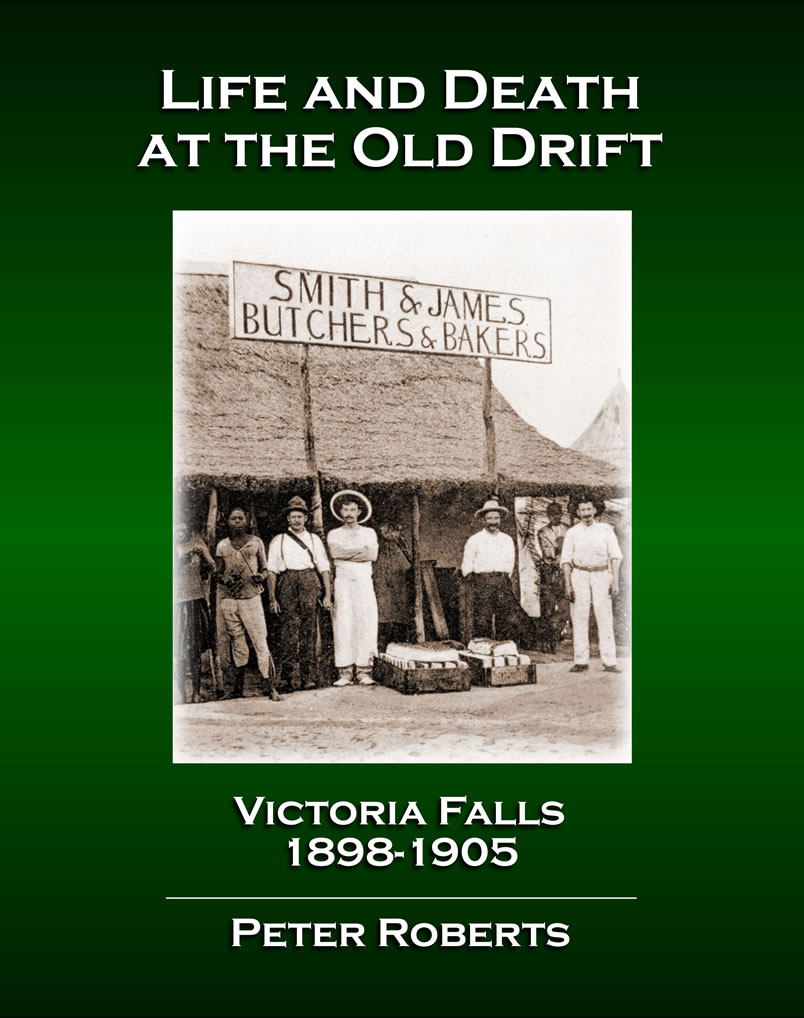
Life and Death at the Old Drift
Victoria Falls 1898-1905
The following text is adapted from 'Life and Death at the Old Drift, Victoria Falls (1898-1905)', researched and written by Peter Roberts and published in 2018 (fifth edition published November 2024 available through Amazon).
A Dangerous Profession
Watt records the arrival of the first two chemists at the Drift, Findlay and Guthrie, adding that both died of blackwater fever.
“Always needed at the Old Drift was a place where medicines could be obtained. The first chemists were Findlay and Guthrie, but they lasted only a short time, contracting black-water fever and dying.” (Watt, undated)
It is thought that only Guthrie was a chemist - Findlay is identified as a general merchant by several sources. Guthrie’s grave, if he is indeed buried at the Drift, is un-marked, although there is a possibility that he is the chemist soon after recorded by Rev Louis Jalla, who visited the settlement in March 1903, as travelling south with Coisson.
“...a chemist. The latter has only been in the country for three months but has been so unwell that he has gone back to Bulawayo with the Coissons.” (News From Barotsiland, June 1903)
Findlay, who was a general merchant, went on to establish the business of Findlay and Co, receiving a liquor trading license and operating for some months before his death in January 1904. Mr David Smith was employed as storekeeper and appears to have taken over the business until his death in April 1905.
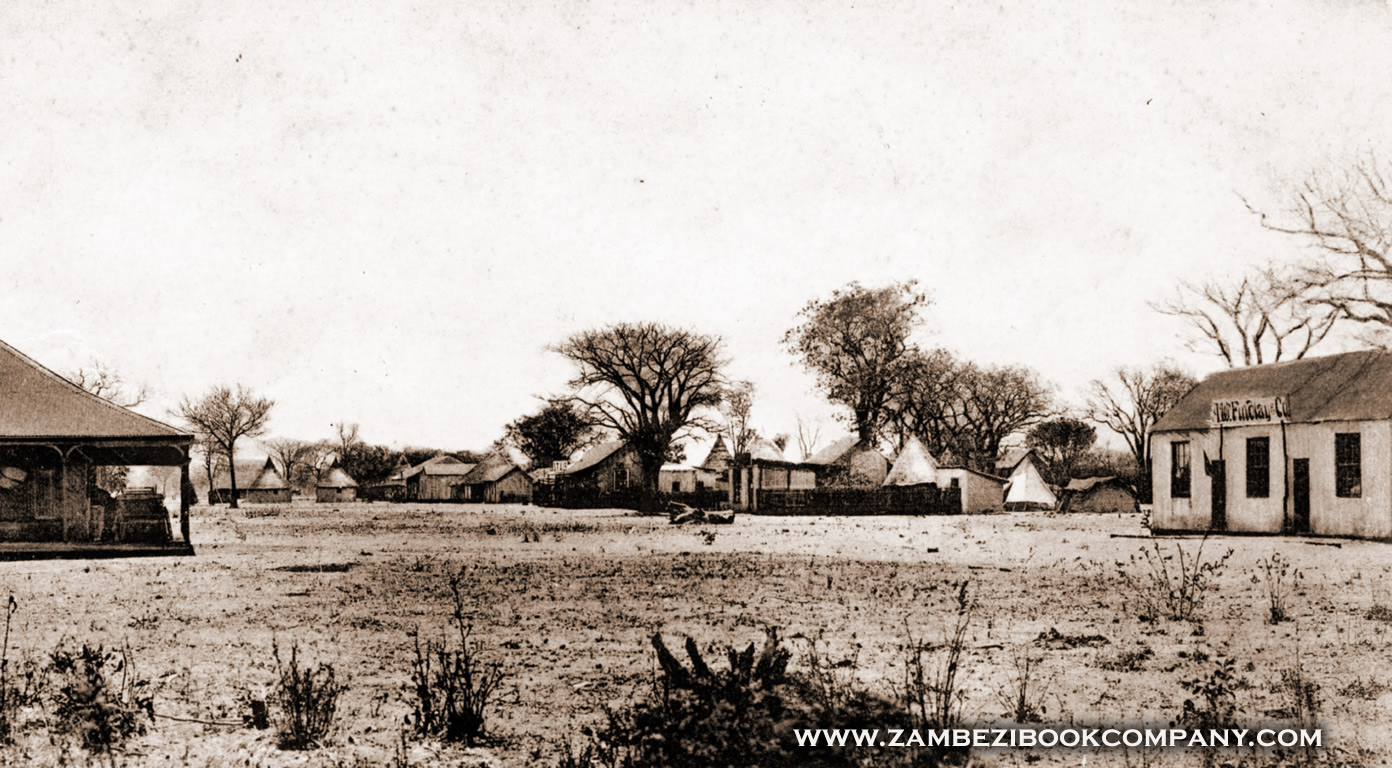
An early view of the Old Drift settlement, with Finlay and Guthries store on the right.
The role of chemist appears to have been a perilous profession at the Drift, with Mr Southurst the next to succumb to fever.
“The next chemist was a Mr Southurst, representing a Bulawayo firm of Chemists, Gornath and Duncan. This man also developed a fever and in his delirium ran off into the bush.” (Watt, undated)
In December 1904 the Bulawayo Chronicle recorded:
“Fever has commenced to take off its victims already, several deaths being reported from the Drift within the last fortnight. Among these, old Bulawayans will regret to hear, were Messrs Eyting and Southurst. The little cemetery at Livingstone is filling up rapidly, and conspicuous amongst the graves is the neat headstone recently erected to the memory of Dr Wilson, one of Bulawayo’s earliest pioneers, and one time medic, town councillor, and right good sportsman.” (Bulawayo Chronicle, December 1904a)
Percy Clark again recalled the unfortunate details.
“Our chemist disappeared one day. He had been delirious for some time. For over a week he was lost - then he was found dead in the bush two or three miles [3-5 km] out from the settlement, his body in a dreadful state of putrefaction. The undertaker got very drunk before facing the job of bringing it in; none envied him the job; notwithstanding a plentiful supply of quick-lime. The chemist was buried at midnight by the light of torches, and when lowered into the grave the coffin also was covered with chloride of lime. This was the second occasion when I was present that the undertaker fell into the grave; this time it was because he was tight. Joe was so tight, in fact, that in spite of the chloride of lime he refused to shift from the top of the coffin, and had to be hauled out by main force. There was some excuse, of course, for Joe’s getting drunk.” (Clark, 1936)
Leopold Frank (later Sir) Moore and his wife, Katherine, arrived on the banks of the Zambezi in 1904, where he would become a central figure in the early development of the European community. A Chemist by profession, Moore came to the Zambezi with the railway, having arrived in Mafeking in 1894 and then moving on to Bulawayo in 1896, where he had established a pharmacy. Moore soon found himself in a dispute with the Administration over plans to import cheap Chinese labour, which he opposed, with the result that his business was supposedly boycott by the Company and soon went into bankruptcy. Arriving on the north bank Moore took over the vacant role of chemist - the forth to set up business in as many years.
“In 1904 the man who was to prove very rapidly an able leader and was to influence the future of the township of Livingstone arrived. Leopold Frank Moore came north and settled at the Old Drift with his wife. Moore left Southern Rhodesia under a cloud of malevolence on the part of the British South Africa Company. He had opposed the Administration on certain counts, especially the matter concerning the introduction of Chinese labour. Moore became the chemist, the others having passed away. His building was made of wood and iron and Mrs Moore wrote in a short article entitled ‘Pioneering by a Woman:’
“‘He had put up a wood and iron store; I can always laugh when I think of him building it and the shape he got it into - it was square and you could see three sides at once. Then it fell down, while he was on top.’” (Watt, undated)
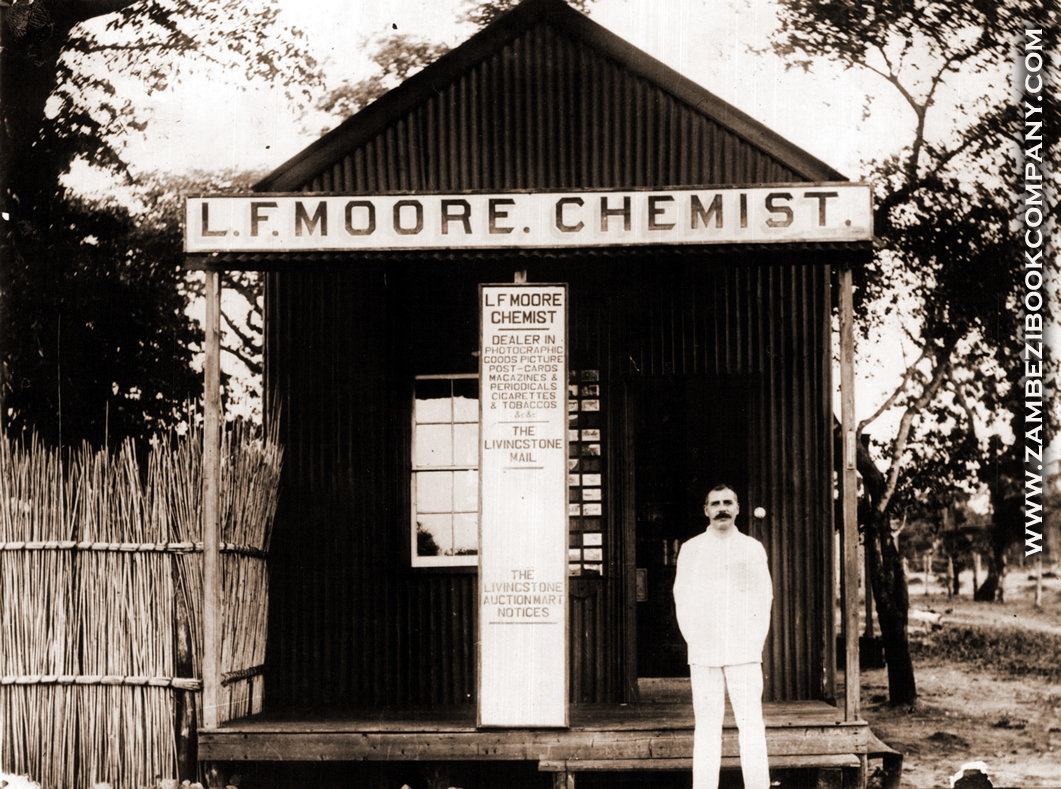
Leopold Moore's first Chemist's shop at the Old Drift, 1904.
References
Clark, P. M. (1936) Autobiography of an Old Drifter. Harrap, London.
Watt, A. (undated) History of Livingstone. Unpublished document held by Livingstone Museum, c1960s. [LMA]
- Go back to the Old Drift feature section index.