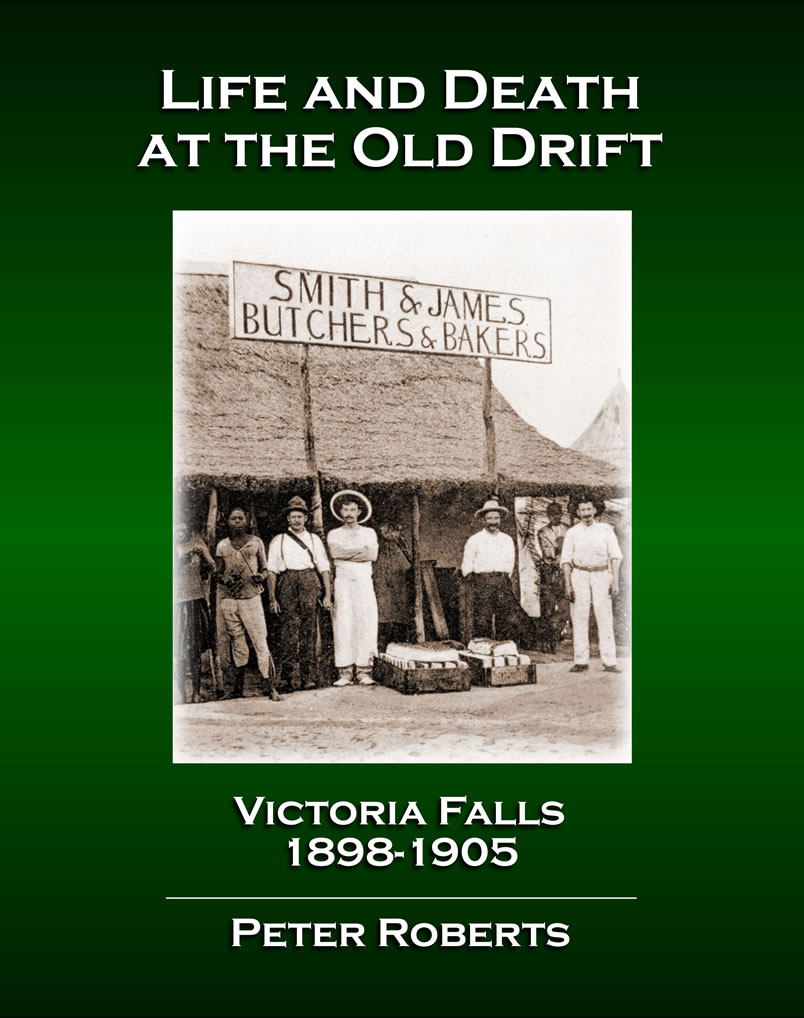
Life and Death at the Old Drift
Victoria Falls 1898-1905
The following text is adapted from 'Life and Death at the Old Drift, Victoria Falls (1898-1905)', researched and written by Peter Roberts and published in 2018 (fifth edition published November 2024 available through Amazon).
Last of the Transport Riders
In late 1904 a large convoy of 75 Europeans travelling with eleven wagons and 1,200 head of cattle arrived on the banks of the Zambezi opposite the Old Drift. Consisting of whole families, young and old, the group had travelled en masse from Bulawayo seeking new pastures north of the river.
“Many of those who settled in the Bulawayo district were connected with transport riding, and when the railways opened up the country they were in danger of losing their livelihood. Some of them thereupon decided to go north, having heard stories of the country from the hardy prospectors, hunters and others. Hacking their way through virgin bush, members of the party eventually reached the Zambesi, and for some time outspanned on the south bank waiting for the level of the river to drop. After a dress rehearsal, when some 30 head of cattle were driven to and from the north bank, it was decided to make the crossing on November 12th.”
After gathering for “a few words of inspiration followed by a prayer and the hymn, ‘Abide With Me’” the families prepared for the crossing. One of the party, Mr Martinus Bezuidenhout, was six years old at the time and later recalled:
“First, Mr Daan Oosthuizen’s wagon entered the water; my father’s wagon followed, and then the various other wagons lumbered across in turn. Ahead of the first wagon were about forty head of cattle swimming for the north bank; they were driven ahead as an enticement for the oxen of the leading wagon. The long giraffe whips soon came into play and the wagons followed each other at about forty-yard intervals. The horses were tied behind the wagons and also had to swim for dear life. The rest of the cattle were swimming on both sides of the wagons guarded by canoes with the oarsmen creating a noise that echoed far into the distance. With eleven covered wagons, each with eighteen Red Afrikander oxen to a span, their heads and horns barely above water, nervous women and children seated in the back of the covered wagons, loose cattle swimming obediently, it was a sight never to be forgotten. It was the most impressive sight ever seen on the mighty Zambesi.”
A large crowd gathered on the north bank to watch the crossing.
“One by one the wagons were cheered by our mixed audience as they climbed out of the river on the north bank. By five o’clock that afternoon everything had returned to normal, and peace and quiet reigned once more.” (Rhodesia Railways Magazine, January 1960)
After achieving their aim the convoy dispersed, some no doubt continuing north to Kalomo and beyond. The Bezuidenhout family settled at the Old Drift for a period. In February 1905 the grandmother, Mrs Nel, was victim of the only known murder at the Drift, being killed by a servant who had accompanied the family from the south.
“Son of a pioneer, Mr Bezuidenhout crossed the Zambesi with his parents by ox-wagon at Old Livingstone and claims that one of the many lonely graves in the district is that of his grandmother, Mrs Nel, who was stabbed to death by her herdboy, who trekked north with them after the Matabele Rebellion. Mr Bezuidenhout says that his father and grandfather set out on horseback and caught the murderer on the banks of the Masamba [Maramba?], where he was hiding in an old grass hut.” (Rhodesia Railways Magazine, August 1954)
Later the same year the family suffered another loss with the death of a young girl of 12 from blackwater fever. Both are recorded as being buried at the small cemetery at the Drift, although their graves are not among those marked.
“The Bezuidenhouts settled first at the Old Drift, and it was there, in February, 1905, that Mr Bezuidenhouts ‘s grandmother was murdered by one of her servants, a native the family had brought up from the South. This was the first crime reported north of the Zambesi. Later that year Mr Bezuidenhouts’s niece, a girl of 12, died of blackwater fever. She was buried near her grandmother in the tiny cemetery.” (Rhodesia Railways Magazine, January 1960)
Another member of the family, Petrus Johannes Bezuidenhout, is also thought to have died at the Drift on 14th December 1904, aged 19.
Mr Martinus Bezuidenhout is believed to have written a book on the family history, although it is not known if it was ever published.
“Mr Bezuidenhout, who has just completed writing a book ‘Beyond the Water that Thunders’, describes the historic crossing.” (Rhodesia Railways Magazine, January 1960)
- Go back to the Old Drift feature section index.